Artist
Morris Louis
1912–1962
Biography
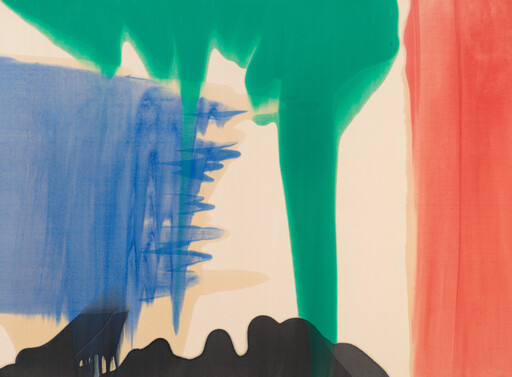
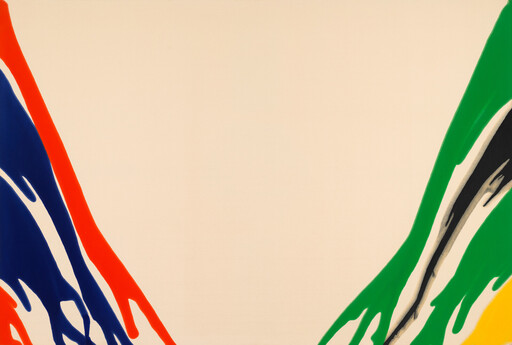
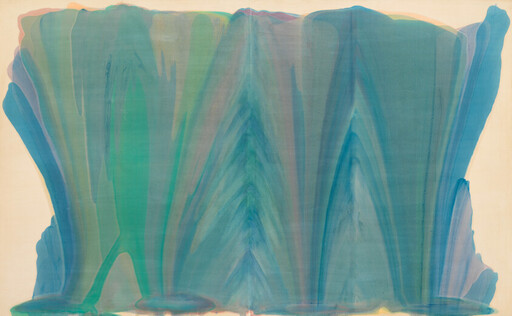
Influenced by the drip painting technique of Jackson Pollock, a group of American artists in the 1950s began to experiment with the effects of diluting and pouring synthetic paints onto unprimed canvas, allowing the paint to spread and bleed, and creating flat areas of color. Chief among them were Helen Frankenthaler in New York and Morris Louis in Washington, DC. Louis visited Frankenthaler’s studio in 1953, and after seeing her recent “stain” paintings he devoted himself to exploring the technique and expanding the style for the next nine years. Louis’s mature paintings are often divided into three series, each numbering over one hundred works, in which he experimented with different compositions: the broad, irregular swaths of often overlapping color of the Veils (1954, 1958– 59); the brightly colored, poured ribbons that uncoil over the bottom edges of the Unfurleds (1960–61); and the multicolor bands that overlap and extend horizontally or vertically across the Stripes (1961–62).
Addition II, one of the Veils, differs from earlier paintings in the series with its distinct separation of the broad plumes of color. Louis, like many of the Color Field painters, often left large areas of canvas blank, and the open space in the center of Addition II directs attention outward to the irregular clouds of blue, red, green, and black paint that emanate from the four edges. Critic and friend Clement Greenberg observed that Louis’s staining technique “conveys a sense not only of color as somehow disembodied, and therefore more purely optical, but also of color as a thing that opens and expands the picture plane.”
Works in the collection

Exhibitions at the Whitney
- Spilling Over: Painting Color in the 1960s 2019-03-29 – 2019-08-18
- Where We Are: Selections from the Whitney’s Collection, 1900–1960 2017-04-28 – 2019-06-02
- The Whitney's Collection 2015-09-28 – 2016-04-04
- Synthetic 2009-01-22 – 2009-04-19
- De Kooning to Today: Highlights from the Permanent Collection (2nd floor–Oct 2002) 2002-10-10 – 2003-03-02
- Morris Louis: Paintings 1970-03-31 – 1970-05-10