Artist Biennial On view
Helen Frankenthaler
1928–2011
Biography
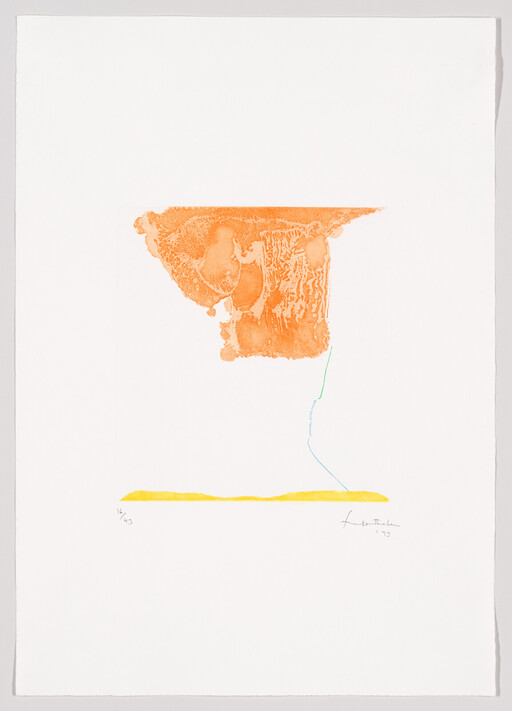
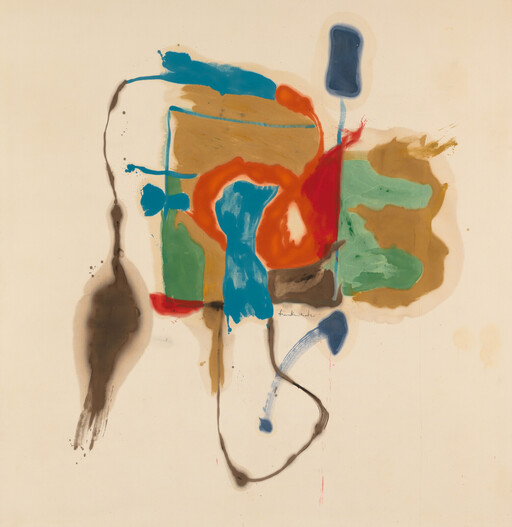
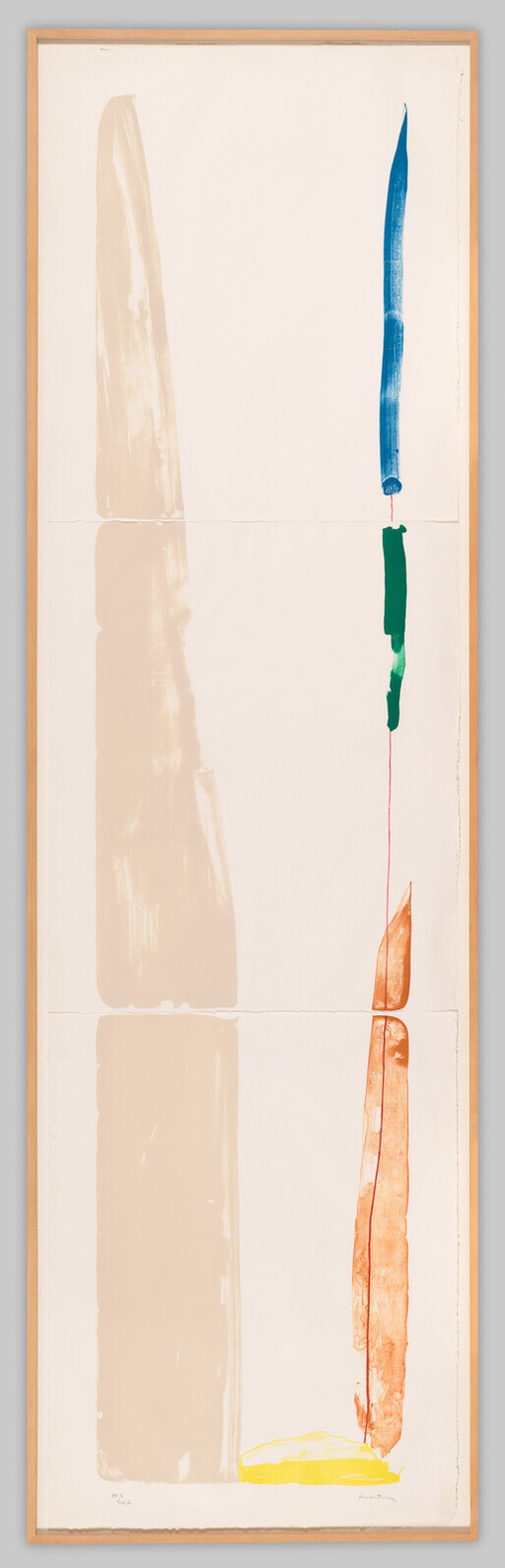
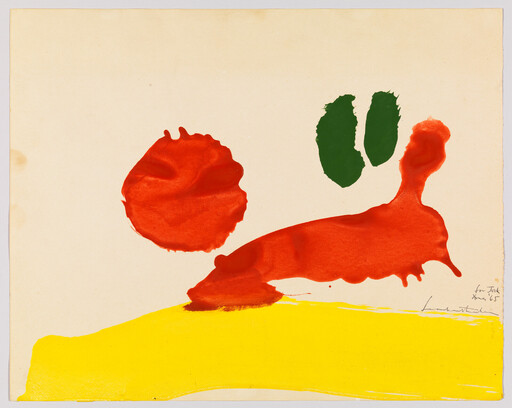
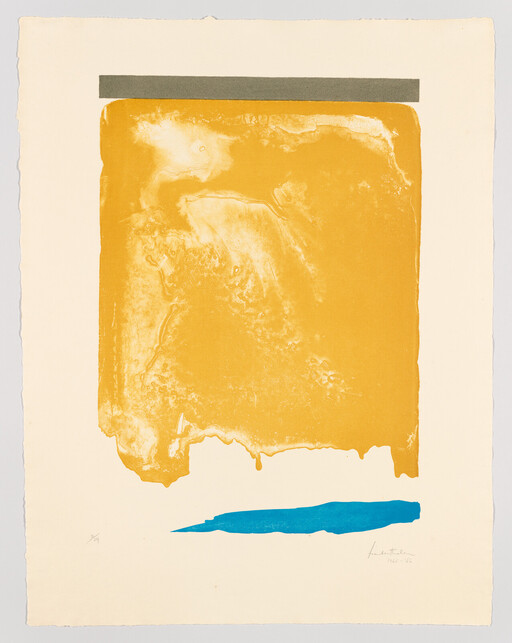
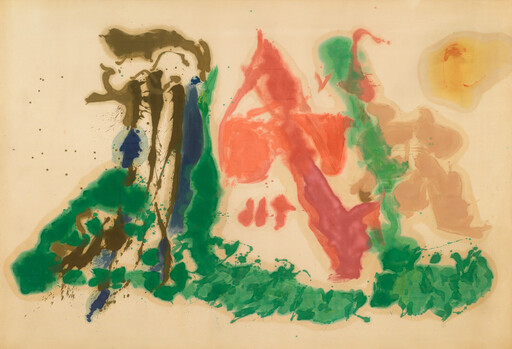
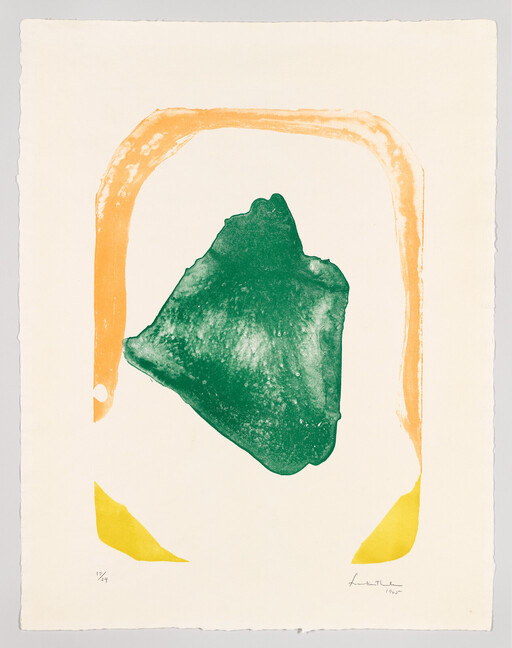
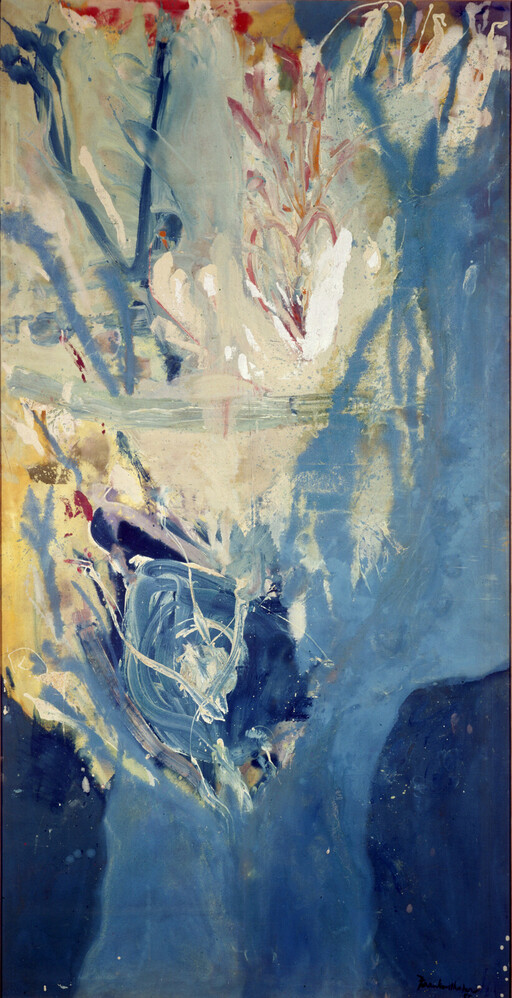
In 1952, near the outset of her career as an abstract painter, Helen Frankenthaler placed canvas onto the floor and poured turpentine-thinned oil paint directly onto the unstretched surface, creating a technique that became known as “stain painting.” This innovative procedure was celebrated for its emphasis on the inherent flatness of the two-dimensional medium. The uneven rate of the paint’s absorption into the raw, unprimed fabric enabled Frankenthaler to create swathes of densely saturated color or areas of diaphanous pooling.
Jackson Pollock’s propulsive dripping and flinging of paint onto horizontally oriented canvases influenced Frankenthaler’s chosen method. Frankenthaler, in turn, inspired her fellow second-generation Abstract Expressionists, including Kenneth Noland and Morris Louis, to adopt staining practices. Critics referred to these artists as either Color Field painters, due to their emphasis on free-form stretches of color, or practitioners of Postpainterly Abstraction, terminology that emphasizes the artists’ replacement of gestural, sweeping brushstrokes with directly poured paint.
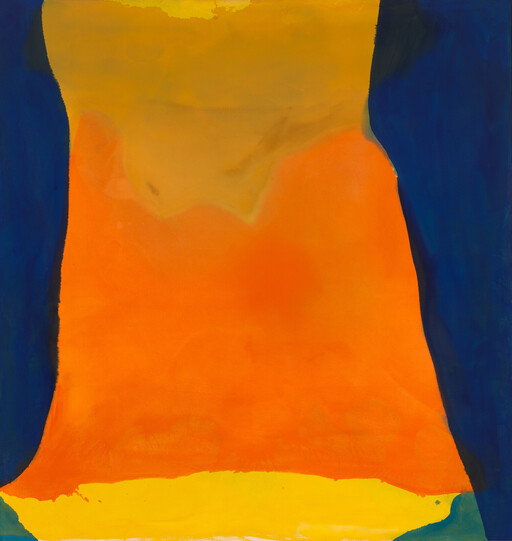
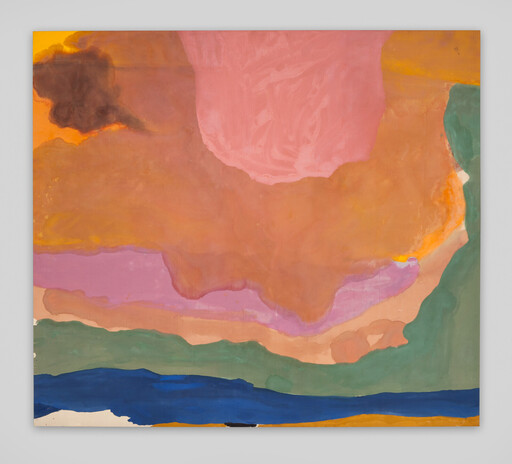
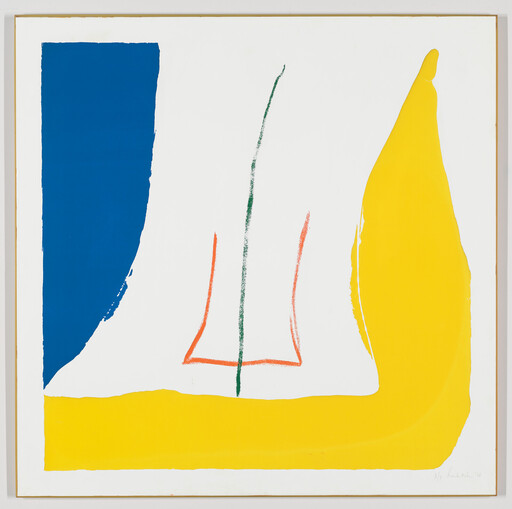
In the early 1960s Frankenthaler began to incorporate acrylic paints into her process. This synthetic medium would dry before it was able to fully soak into the support, “flooding” the canvas with color and leaving her with brighter results. For works such as Flood, she was able to execute forms quickly and create clear delineations between bands of color. If, as she described, “I don’t start with a color order but find the color as I go,” then in Flood she found a deluge of variegation. Despite her abstract working mode, Frankenthaler’s paintings recall the natural world. Flood demonstrates how nonrepresentational striations can also suggest sky, clouds, water, and earth.
Works in the collection
Exhibitions at the Whitney
- Spilling Over: Painting Color in the 1960s 2019-03-29 – 2019-08-18
- The Whitney's Collection 2015-09-28 – 2016-04-04
- Shaping a Collection: Five Decades of Gifts 2014-07-17 – 2014-10-19
- Full House: Views of the Whitney’s Collection at 75 2006-06-29 – 2006-09-03
- An American Legacy, A Gift to New York 2002-10-24 – 2003-01-26
- Whitney Biennial 1973: Contemporary American Art 1973-01-10 – 1973-03-18
- 1972 Annual Exhibition: Contemporary American Painting 1972-01-25 – 1972-03-19
- 1969 Annual Exhibition: Contemporary American Painting 1969-12-16 – 1970-02-01
- Helen Frankenthaler 1969-02-20 – 1969-04-06
- 1967 Annual Exhibition of Contemporary Painting 1967-12-13 – 1968-02-04
- 1965 Annual Exhibition of Contemporary American Painting 1965-12-08 – 1966-01-30
- Annual Exhibition 1963: Contemporary American Painting 1963-12-11 – 1964-02-02
- Annual Exhibition 1961: Contemporary American Painting 1961-12-13 – 1962-02-04
- 1958 Annual Exhibition: Sculpture, Paintings, Watercolors, Drawings 1958-11-19 – 1959-01-04
- 1955 Annual Exhibition of Contemporary American Paintings, Sculpture, Watercolors and Drawings 1955-01-12 – 1955-02-20