Artist Biennial
Philip Guston
1913–1980
Biography
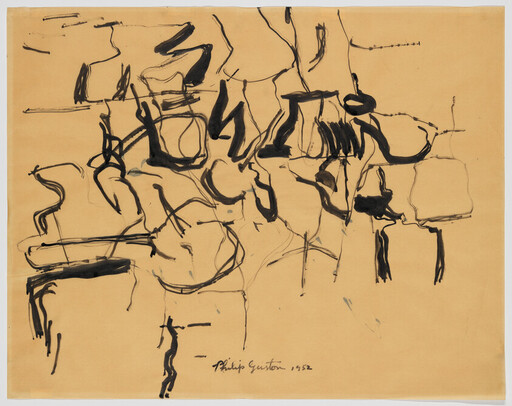
Philip Guston came to the United States from Canada as a young child in 1919 with his Russian émigré parents, who settled their family in California. In 1927 Guston enrolled in Manual Arts High School in Los Angeles, where, together with his friend and classmate Jackson Pollock, he was soon expelled for producing satirical broadsides. Continuing his artistic and intellectual explorations largely on his own, he began his formal career making figurative art in styles he explored until the late 1940s, including murals made in the 1930s concerned with political and social issues. After his permanent move to New York in 1949, the figures in Guston’s work gradually disappeared; his canvases became increasingly textured and his color palette more refined until his signature Abstract Expressionist style emerged.
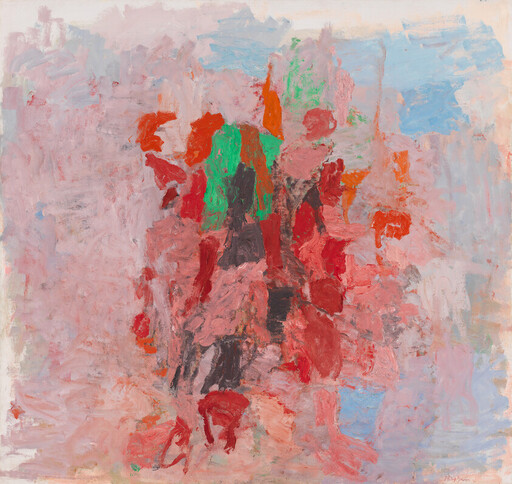
Dial displays Guston’s confident approach to pure abstraction, and the painting glimmers from the use of gestural yet tempered brushstrokes. It includes the artist’s characteristic pinks and reds, with the concentration of color and broader brushwork at the center of the canvas. The composition is structured loosely upon a grid inspired by Piet Mondrian. Guston wrote about the significance of Dial to him, “This picture has a special importance for me as it is a culminating point of a certain period of my painting.” In the late 1960s Guston would follow a path back to figuration, incorporating a cartoon-inflected iconography into his painting. This transformation, which shocked the art establishment at the time, landed him at the forefront of the Neo-Expressionist movement and a new, postmodern era.
Works in the collection
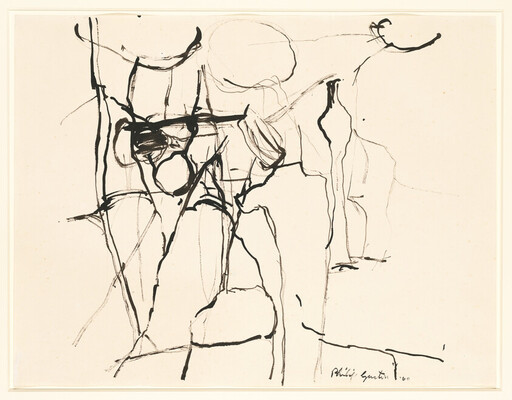
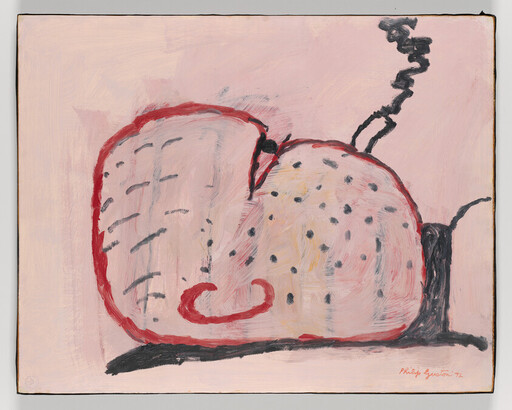
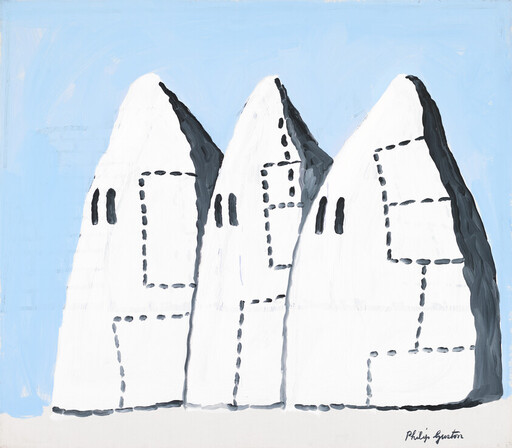
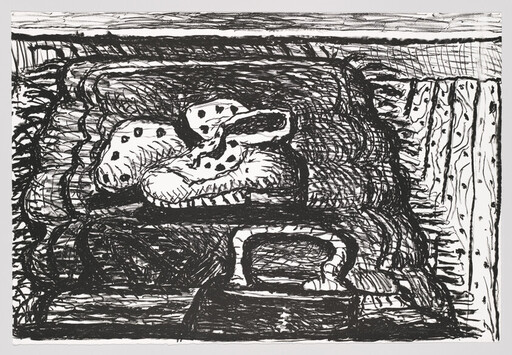
Exhibitions at the Whitney
- Vida Americana: Mexican Muralists Remake American Art, 1925–1945 2020-02-17 – 2021-01-31
- The Whitney's Collection 2015-09-28 – 2016-04-04
- America Is Hard to See 2015-05-01 – 2015-09-27
- Real/Surreal 2011-10-06 – 2012-02-12
- Collecting Biennials 2010-01-16 – 2010-11-28
- The Whitney’s Collection 2008-01-30 – 2010-01-03
- Full House: Views of the Whitney’s Collection at 75 2006-06-29 – 2006-09-03
- De Kooning to Today: Highlights from the Permanent Collection (2nd floor–Oct 2002) 2002-10-10 – 2003-03-02
- An American Story 1996-03-20 – 1996-09-29
- Whitney Biennial 1979 1979-02-06 – 1979-04-01
- Annual Exhibition 1963: Contemporary American Painting 1963-12-11 – 1964-02-02
- Annual Exhibition 1962: Contemporary Sculpture and Drawings 1962-12-12 – 1963-02-03
- Annual Exhibition 1961: Contemporary American Painting 1961-12-13 – 1962-02-04
- 1958 Annual Exhibition: Sculpture, Paintings, Watercolors, Drawings 1958-11-19 – 1959-01-04
- 1957 Annual Exhibition: Sculpture, Paintings, Watercolors 1957-11-20 – 1958-01-12
- 1956 Annual Exhibition: Sculpture, Paintings, Watercolors, Drawings 1956-11-14 – 1957-01-06
- 1956 Annual Exhibition of Contemporary American Sculpture, Watercolors and Drawings 1956-04-18 – 1956-06-10
- 1955 Annual Exhibition of Contemporary American Paintings, Sculpture, Watercolors and Drawings 1955-01-12 – 1955-02-20
- 1953 Annual Exhibition of Contemporary American Painting 1953-10-15 – 1953-12-06
- 1953 Annual Exhibition of Contemporary American Sculpture, Watercolors and Drawings 1953-04-09 – 1953-05-29
- 1952 Annual Exhibition of Contemporary American Sculpture, Watercolors and Drawings 1952-03-13 – 1952-05-04
- 1951 Annual Exhibition of Contemporary American Sculpture, Watercolors and Drawings 1951-03-17 – 1951-05-06
- 1950 Annual Exhibition of Contemporary American Painting 1950-11-10 – 1950-12-31
- 1950 Annual Exhibition of Contemporary American Sculpture, Watercolors and Drawings 1950-04-01 – 1950-05-28
- 1948 Annual Exhibition of Contemporary American Painting 1948-11-13 – 1949-01-02
- 1947 Annual Exhibition of Contemporary American Painting 1947-12-06 – 1948-01-25
- 1946 Annual Exhibition of Contemporary American Painting 1946-12-10 – 1947-01-16
- 1946 Annual Exhibition of Contemporary American Sculpture, Watercolors and Drawings 1946-02-05 – 1946-03-13
- 1945 Annual Exhibition of Contemporary American Painting 1945-11-27 – 1946-01-10
- 1944 Annual Exhibition of Contemporary American Painting 1944-11-14 – 1944-12-12
- 1943 Annual Exhibition of Contemporary American Art 1943-11-23 – 1944-01-04
- 1942 Annual Exhibition of Contemporary American Art 1942-11-24 – 1943-01-06
- 1940 Annual Exhibition of Contemporary American Art 1940-01-10 – 1940-02-18
- 1938 Annual Exhibition of Contemporary American Painting 1938-11-02 – 1938-12-11