Artist Biennial On view
Georgia O'Keeffe
1887–1986
Biography
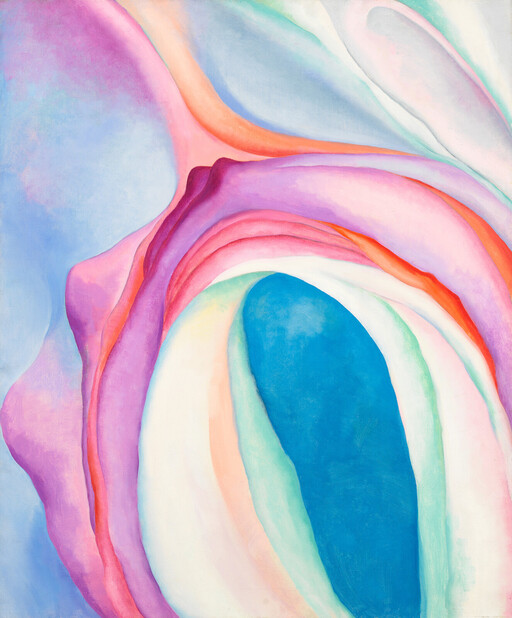
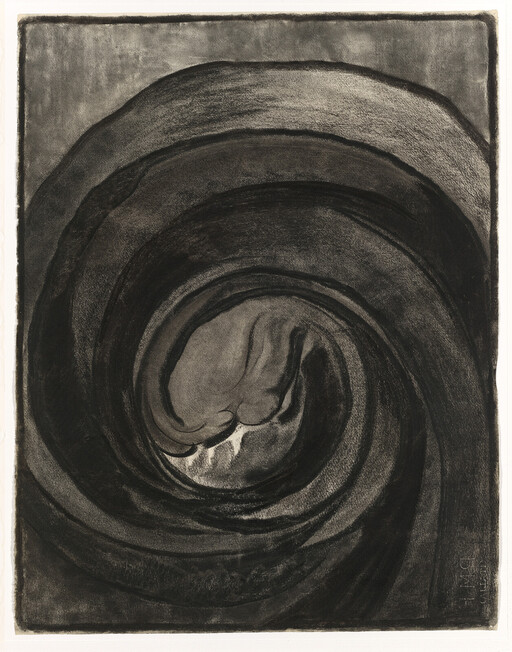
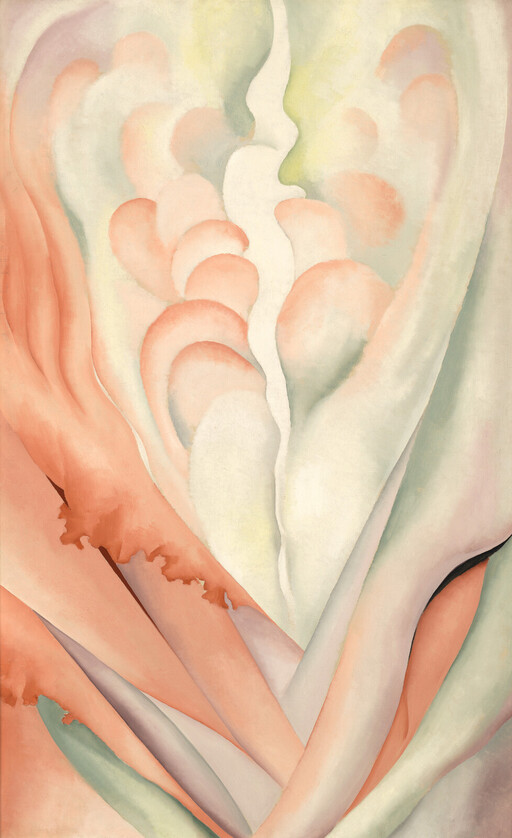
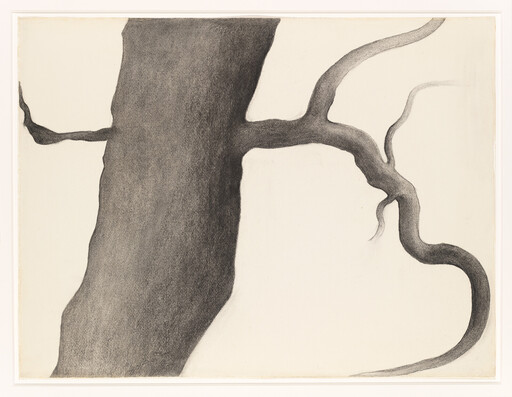
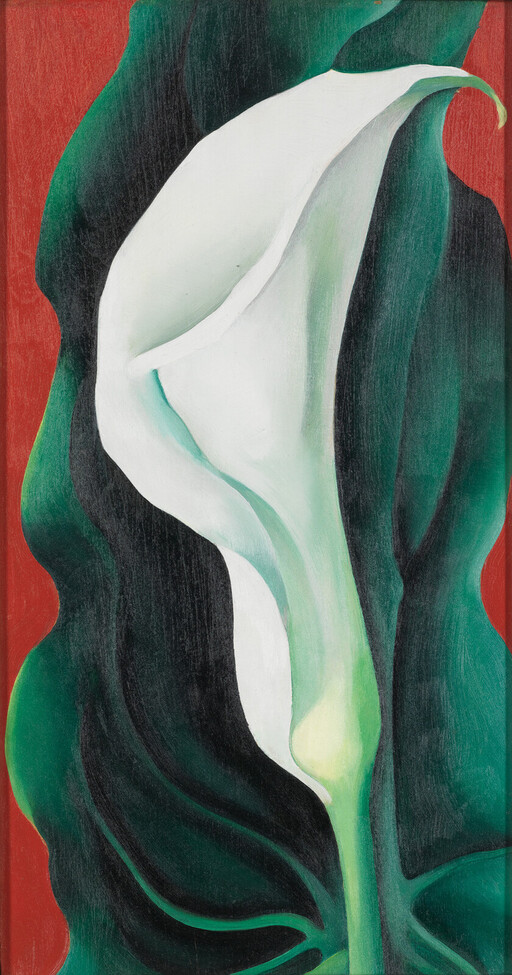
Georgia O’Keeffe used her art to record emotional and sensory experiences, especially her responses to the rhythms and forms of the natural world. Raised on a dairy farm in rural Wisconsin, O’Keeffe attended the Art Students League and Teacher’s College at Columbia University in New York, where she trained to be an art teacher. She first came to the attention of the New York art world in the spring of 1916 when her radically abstract charcoal drawings were exhibited at Alfred Stieglitz’s pioneering 291 gallery. The artist described the simple, organic motifs of these works, including the spiral form that appears in No. 8 – Special (Drawing No. 8), as vehicles for conveying feelings she could not put into words. “Abstraction,” she remarked, “is often the most definite form for the intangible thing in myself that I can only clarify in paint.” As O’Keeffe expanded her repertoire in 1918 to include oil, she retained the fluid space and curvilinear motifs of her early charcoals. Music, Pink and Blue No. 2, for example, uses gently feathered brushwork and a vibrant palette to evoke the undulating rhythms of nature. Such an approach marked a departure from the fractured geometric language, inspired by European Cubism, which dominated vanguard American painting in the early twentieth century. Yet as the painting’s title suggests, O’Keeffe—like many of her modernist colleagues in the United States and Europe—was interested in exploring the correlation between abstract painting and music as nonverbal forms of emotional expression.
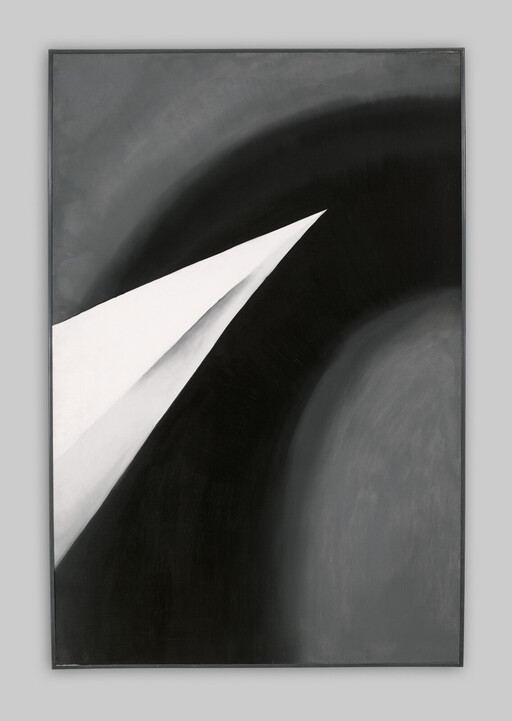
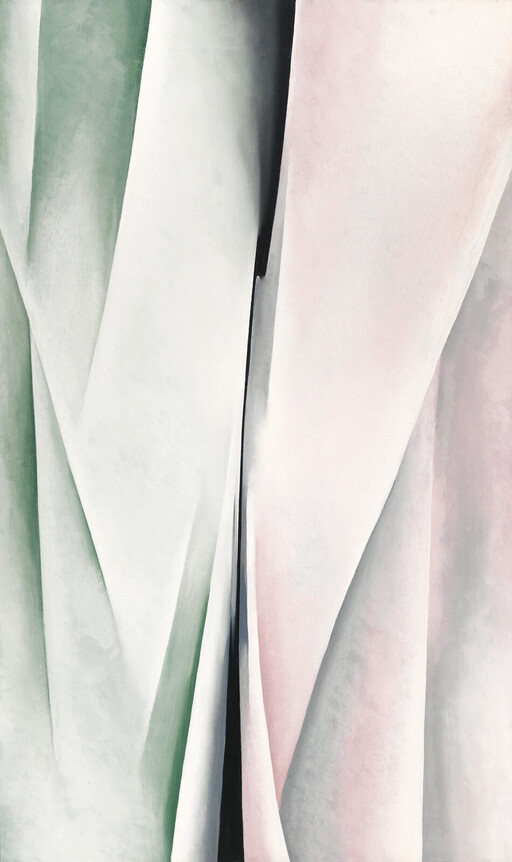
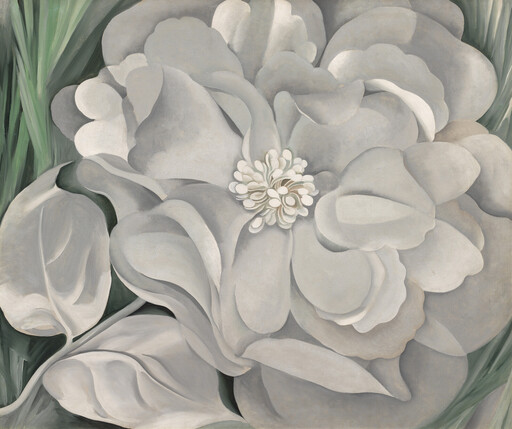
Throughout her long and prolific career, O’Keeffe continued to produce highly abstract works, such as the geometric Black and White, which she mysteriously described as “a message to a friend.” By the mid-1920s, however, she also began painting images with recognizable subjects, earning particular acclaim for her depictions of flowers. In works such as The White Calico Flower, O’Keeffe eschewed the traditional figure-ground format of still-life painting, opting instead to dramatically enlarge her botanical subjects so that they oscillate between abstraction and representation. The subject of this painting was not a live specimen, but a cloth flower used in Southwestern mourning rituals. O’Keeffe’s use of cropping and magnification in this and other flower compositions reflected her interest in modernist photographic techniques, which she encountered through her close relationships with photographers Paul Strand and Stieglitz, whom she married in 1924. Filling the entire frame of the canvas, O’Keeffe’s flowers are neither diminutive nor ephemeral—rather, they are objects of commanding monumentality. Although critics often discussed the flower paintings in sexual terms, O’Keeffe rejected these interpretations, suggesting instead that they were intended to surprise viewers and call attention to the overlooked details of the natural world.
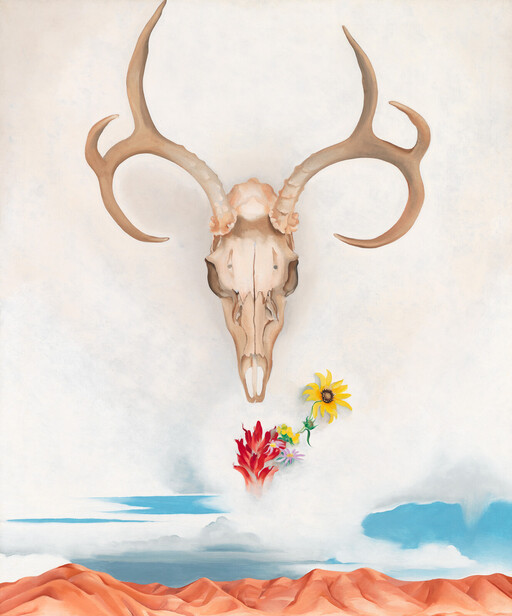
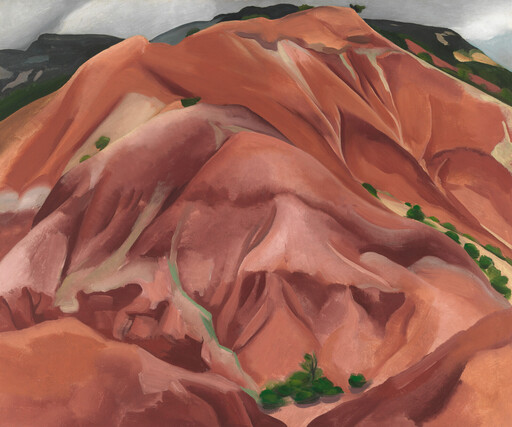
In 1929, O’Keeffe began spending parts of each year working in New Mexico, to which she moved permanently in 1949. She drew inspiration from the stark desert landscape as well as the organic objects she collected there, including animal bones, stones, and feathers. The floating animal skull that appears at the center of Summer Days was a motif that O’Keeffe introduced in 1931, when she began painting bones that she had brought back east from her New Mexico sojourns. The desiccated, sun-bleached skull is paired here with—and yet stands in stark contrast to—a group of vibrantly blooming desert wildflowers. Hovering in the clouds over a distant line of red clay hills, the skull and flowers present a distinctive iconography of the American Southwest. And at the same time, with its distorted scale and enigmatic symbols of life and death, the painting demonstrates O’Keeffe’s awareness of the incongruous aesthetic juxtapositions employed by Surrealist artists working in Europe and the United States during the same period.
Dana Miller and Adam D. Weinberg, Handbook of the Collection (New York: Whitney Museum of American Art, 2015), 286–288.
Works in the collection
Exhibitions at the Whitney
- At the Dawn of a New Age: Early Twentieth-Century American Modernism 2022-05-07 – 2023-02-26
- The Whitney’s Collection: Selections from 1900 to 1965 2019-06-28 – 2025-05-01
- Where We Are: Selections from the Whitney’s Collection, 1900–1960 2017-04-28 – 2019-06-02
- Human Interest: Portraits from the Whitney’s Collection 2016-04-02 – 2017-04-02
- The Whitney's Collection 2015-09-28 – 2016-04-04
- America Is Hard to See 2015-05-01 – 2015-09-27
- American Legends: From Calder to O’Keeffe 2012-12-22 – 2014-06-29
- Breaking Ground: The Whitney’s Founding Collection 2011-04-28 – 2011-09-18
- Legacy: The Emily Fisher Landau Collection 2011-02-10 – 2011-05-01
- Singular Visions 2010-12-16 – 2012-08-05
- Modern Life: Edward Hopper and His Time 2010-10-28 – 2011-04-10
- Georgia O’Keeffe: Abstraction 2009-09-17 – 2010-01-17
- The Whitney’s Collection 2008-01-30 – 2010-01-03
- Modernisms 2007-08-29 – 2008-01-13
- Full House: Views of the Whitney’s Collection at 75 2006-06-29 – 2006-09-03
- Highlights from the Permanent Collection: From Hopper to Mid-Century 2000-02-26 – 2006-05-21
- Permanent Collection 1998-04-04 – 1999-03-28
- An American Story 1996-03-20 – 1996-09-29
- American Modernist Drawings from the Permanent Collection 1994-06-09 – 1994-09-10
- Georgia O'Keeffe: A Concentration of Works from the Permanent Collection of the Whitney Museum of American Art 1981-07-08 – 1981-10-04
- 1972 Annual Exhibition: Contemporary American Painting 1972-01-25 – 1972-03-19
- Georgia O'Keeffe 1970-10-08 – 1970-11-29
- 1967 Annual Exhibition of Contemporary Painting 1967-12-13 – 1968-02-04
- 1965 Annual Exhibition of Contemporary American Painting 1965-12-08 – 1966-01-30
- Annual Exhibition 1963: Contemporary American Painting 1963-12-11 – 1964-02-02
- Annual Exhibition 1961: Contemporary American Painting 1961-12-13 – 1962-02-04
- 1959 Annual Exhibition of Contemporary American Painting 1959-12-09 – 1960-01-31
- 1958 Annual Exhibition: Sculpture, Paintings, Watercolors, Drawings 1958-11-19 – 1959-01-04
- 1957 Annual Exhibition: Sculpture, Paintings, Watercolors 1957-11-20 – 1958-01-12
- 1956 Annual Exhibition: Sculpture, Paintings, Watercolors, Drawings 1956-11-14 – 1957-01-06
- 1955 Annual Exhibition of Contemporary American Painting 1955-11-09 – 1956-01-08
- 1955 Annual Exhibition of Contemporary American Paintings, Sculpture, Watercolors and Drawings 1955-01-12 – 1955-02-20
- 1953 Annual Exhibition of Contemporary American Painting 1953-10-15 – 1953-12-06
- 1950 Annual Exhibition of Contemporary American Painting 1950-11-10 – 1950-12-31
- 1949 Annual Exhibition of Contemporary American Painting 1949-12-16 – 1950-02-05
- 1948 Annual Exhibition of Contemporary American Painting 1948-11-13 – 1949-01-02
- 1946 Annual Exhibition of Contemporary American Painting 1946-12-10 – 1947-01-16
- 1945 Annual Exhibition of Contemporary American Painting 1945-11-27 – 1946-01-10
- 1944 Annual Exhibition of Contemporary American Painting 1944-11-14 – 1944-12-12
- 1943 Annual Exhibition of Contemporary American Art 1943-11-23 – 1944-01-04
- 1942 Annual Exhibition of Contemporary American Art 1942-11-24 – 1943-01-06
- Second Biennial Exhibition of Contemporary American Painting 1934-11-27 – 1935-01-10
- First Biennial Exhibition of Contemporary American Painting 1932-11-22 – 1933-01-05