Artist Biennial
Lee Krasner
1908–1984
Biography
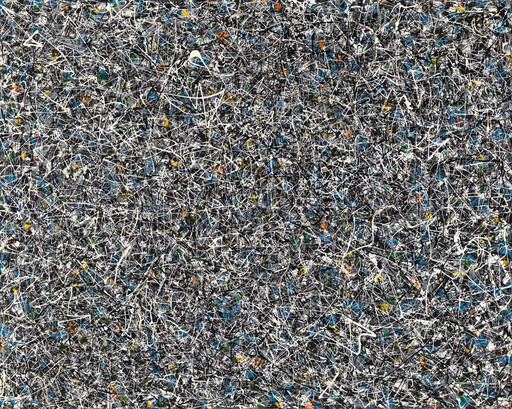
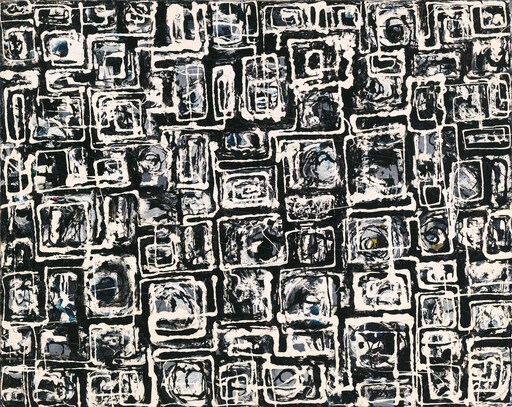
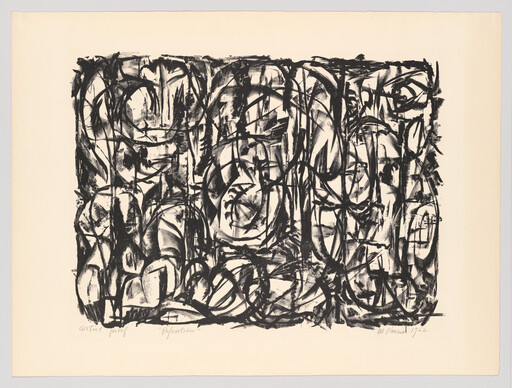
In the mid and late 1940s, Lee Krasner, one of the few women associated with Abstract Expressionism’s first generation, developed compositions comprised of small, interconnected boxes with symbols that she described as hieroglyphic. Using a limited palette and paint applied in thick, controlled drips, Krasner achieved the nonhierarchical, allover format that she and her Abstract Expressionists peers favored.
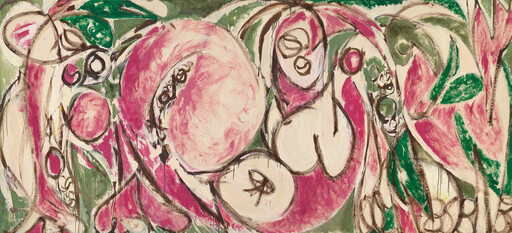
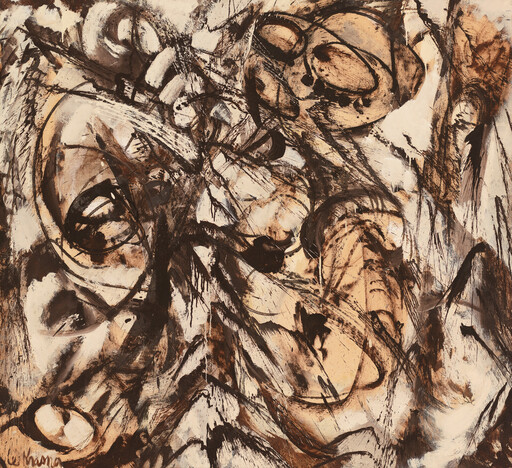
Yet the diminutive scale of Krasner’s early work was in part a consequence of her studio space. Krasner completed many of these canvases in an upstairs bedroom of the Long Island home she shared with her husband, Jackson Pollock. After she recovered from the shock of Pollock’s death in a car accident in 1956, Krasner began to paint in the barn on their property that had previously been his studio. She made the most of the increased space: nearly seventeen feet wide and more than seven feet in height, The Seasons was the largest work she had attempted up to that point.
The composition, a signal example of a group of late 1950s paintings often referred to as the Earth Green series, interweaves sweeping black brushstrokes with swaths of pink, bulbous shapes in off-white, and sections of lush green. Her energetic markings evoke the female body and botanical forms, organic elements tied to growth and the inevitable cycles of nature. Krasner explained that in the wake of the sudden loss of her husband, “the question came up whether one would continue painting at all, and I guess this was my answer.”
Dana Miller and Adam D. Weinberg, Handbook of the Collection (New York: Whitney Museum of American Art, 2015), 211.
Works in the collection
Exhibitions at the Whitney
- Labyrinth of Forms:<br>Women and Abstraction, 1930–1950 2021-10-09 – 2022-03-13
- The Whitney’s Collection: Selections from 1900 to 1965 2019-06-28 – 2025-05-01
- The Whitney's Collection 2015-09-28 – 2016-04-04
- America Is Hard to See 2015-05-01 – 2015-09-27
- Signs & Symbols 2012-06-28 – 2012-10-28
- Singular Visions 2010-12-16 – 2012-08-05
- Modernisms 2007-08-29 – 2008-01-13
- Picasso and American Art 2006-09-28 – 2007-01-28
- Prints into Drawings 2005-04-14 – 2005-08-28
- De Kooning to Today: Highlights from the Permanent Collection (2nd floor–Oct 2002) 2002-10-10 – 2003-03-02
- Highlights from the Permanent Collection: From Hopper to Mid-Century 2000-02-26 – 2006-05-21
- Collection in Context: 1948 1998-01-16 – 1998-03-15
- An American Story 1996-03-20 – 1996-09-29
- Prints from the 1950s and Early 1960s: Selections from the Collection 1995-10-25 – 1996-01-21
- In a Classical Vein: Works from the Permanent Collection 1993-10-18 – 1994-04-03
- Lee Krasner: Large Paintings 1973-11-13 – 1974-01-08
- Whitney Biennial 1973: Contemporary American Art 1973-01-10 – 1973-03-18
- 1957 Annual Exhibition: Sculpture, Paintings, Watercolors 1957-11-20 – 1958-01-12
- 1956 Annual Exhibition: Sculpture, Paintings, Watercolors, Drawings 1956-11-14 – 1957-01-06