Artist Biennial
Mark di Suvero
1933–
Biography
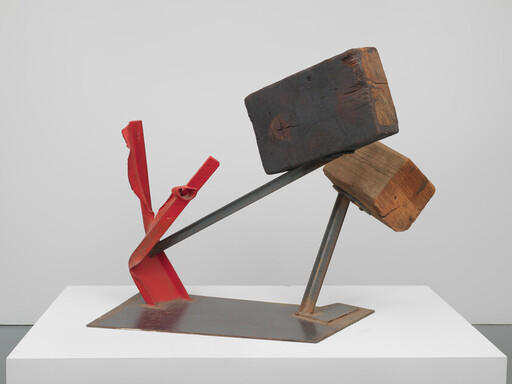
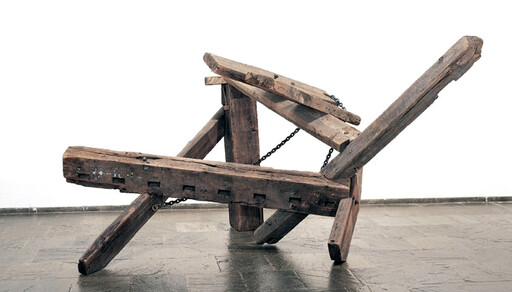
Born in Shanghai to Italian expatriates, Mark di Suvero was raised in San Francisco. He first became interested in sculpture while studying philosophy in college, and started making small constructions of plaster and wax after moving to New York in 1957. The art world was still dominated by Abstract Expressionism, and di Suvero was influenced by painters such as Franz Kline and Clyfford Still, in whose work, as he explained it, “space had some kind of a symbolic value of freedom.” He began to transpose their slashing diagonals and kinetic gestures into large sculptures made of wood and scrap metal scavenged from demolition sites. Hankchampion, a key work from this period, strikes an uneasy balance between the weightiness of its weathered timbers and their precarious, asymmetric configuration, which animates the surrounding space. Although severely injured at the time in an elevator accident that would leave him paralyzed for several years, he was able to finish the sculpture with the assistance of his younger brother, Hank. The title includes Hank’s name as well as that of Champion, the company that provided the chain that girds the construction.
During the course of his rehabilitation, di Suvero learned to operate an electric arc welder and a crane, and since the mid-1960s he has worked primarily in steel. His signature sculptures are composed of I-beams and steel plates that he torques, cuts, and twists into mammoth geometric configurations, often brightly painted and sometimes incorporating kinetic elements. Known for his activism and for his advocacy of fellow artists, di Suvero established the Socrates Sculpture Park in Queens, New York, in 1986.
Works in the collection
Exhibitions at the Whitney
- The Whitney's Collection 2015-09-28 – 2016-04-04
- America Is Hard to See 2015-05-01 – 2015-09-27
- Full House: Views of the Whitney’s Collection at 75 2006-06-29 – 2006-09-03
- Whitney Biennial 2006:<br>Day for Night 2006-03-02 – 2006-05-28
- An American Story 1996-03-20 – 1996-09-29
- In a Classical Vein: Works from the Permanent Collection 1993-10-18 – 1994-04-03
- 1970 Annual Exhibition: Contemporary American Sculpture 1970-12-12 – 1971-02-07
- 1968 Annual Exhibition: Contemporary American Sculpture 1968-12-17 – 1969-02-09
- Annual Exhibition 1966: Contemporary Sculpture and Prints 1966-12-16 – 1967-02-05