Artist Biennial On view
Charles Demuth
1883–1935
Biography
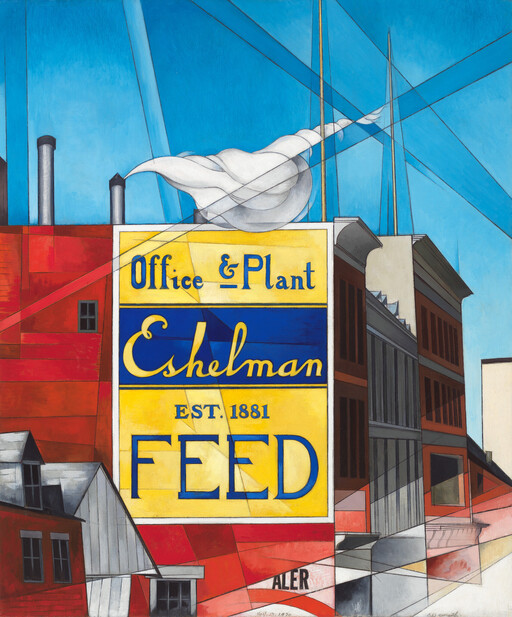
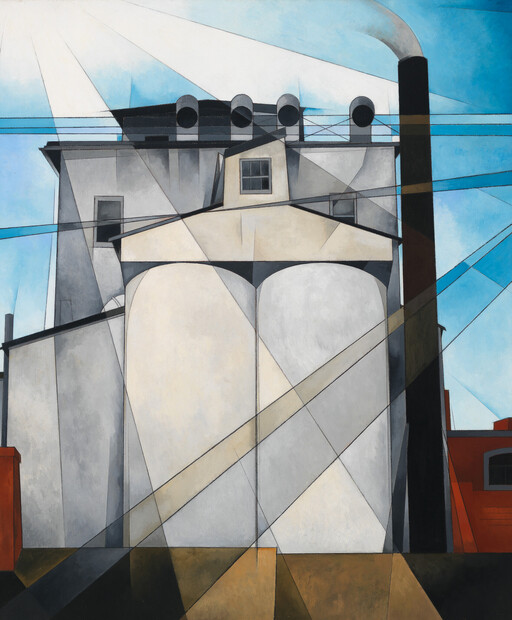
In 1927 Charles Demuth commenced a series of ambitious oil paintings that depict industrial architecture in his native Lancaster, Pennsylvania. In My Egypt he portrays the concrete grain elevator of the John W. Eshelman Feed Company, constructed in 1919. Composed using crisp lines and flat planes of color, the painting is an early example of the Precisionist style, which celebrated the expansion of American industry after World War I. The majestic structure, bathed in overlapping shafts of light, epitomizes American achievement—a modern-day equivalent, as the title suggests, of the pyramids of ancient Egypt. While linked to national themes, My Egypt is nonetheless infused with personal meaning. Ailing with diabetes, Demuth was increasingly confined to his family’s home in Lancaster— far from the sophisticated milieu he had frequently enjoyed in New York. By designating the image his Egypt, Demuth links Lancaster to the Biblical connotation of Egypt as a site of involuntary bondage, while also summoning the pyramid’s symbolic association with life after death.
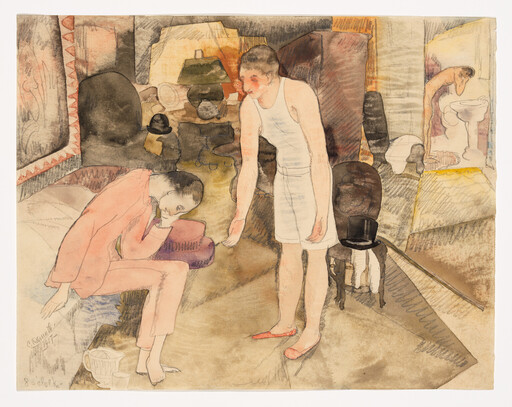
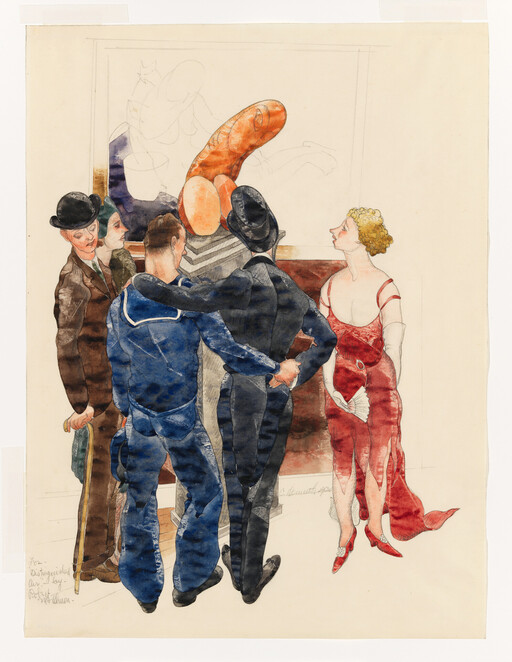
Despite his success working in oil, watercolor was Demuth’s favored medium. His watercolors often suggest an underground sexual freedom and licentiousness, subjects that must have had particular resonance for the artist as a homosexual in a largely inhospitable culture. Distinguished Air, inspired by a short story by the American writer Robert McAlmon, portrays a woman in a provocative evening dress and two couples, one homosexual and the other heterosexual. All are at an art exhibition, viewing Constantin Brancusi’s famous sculpture Princess X (1915–16), whose phallic form the artist humorously accentuates.
Works in the collection
Exhibitions at the Whitney
- At the Dawn of a New Age: Early Twentieth-Century American Modernism 2022-05-07 – 2023-02-26
- The Whitney’s Collection: Selections from 1900 to 1965 2019-06-28 – 2025-05-01
- Where We Are: Selections from the Whitney’s Collection, 1900–1960 2017-04-28 – 2019-06-02
- Human Interest: Portraits from the Whitney’s Collection 2016-04-02 – 2017-04-02
- The Whitney's Collection 2015-09-28 – 2016-04-04
- America Is Hard to See 2015-05-01 – 2015-09-27
- American Legends: From Calder to O’Keeffe 2012-12-22 – 2014-06-29
- Whitney Biennial 2012 2012-03-01 – 2012-05-27
- Breaking Ground: The Whitney’s Founding Collection 2011-04-28 – 2011-09-18
- Modern Life: Edward Hopper and His Time 2010-10-28 – 2011-04-10
- Chimneys and Towers: <br>Charles Demuth’s Late Paintings of Lancaster 2008-02-23 – 2008-04-27
- The Whitney’s Collection 2008-01-30 – 2010-01-03
- Modernisms 2007-08-29 – 2008-01-13
- Full House: Views of the Whitney’s Collection at 75 2006-06-29 – 2006-09-03
- Highlights from the Permanent Collection: From Hopper to Mid-Century 2000-02-26 – 2006-05-21
- Permanent Collection 1998-04-04 – 1999-03-28
- An American Story 1996-03-20 – 1996-09-29
- In a Classical Vein: Works from the Permanent Collection 1993-10-18 – 1994-04-03
- Masters of American Watercolor 1962-02-13 – 1962-03-04
- Charles Demuth Memorial Exhibition 1937-12-15 – 1938-01-16
- Second Biennial Exhibition of Contemporary American Painting 1934-11-27 – 1935-01-10
- First Biennial Exhibition of Contemporary American Sculpture, Watercolors and Prints 1933-12-05 – 1934-01-11
- First Biennial Exhibition of Contemporary American Painting 1932-11-22 – 1933-01-05