Artist Biennial
John Steuart Curry
1897–1946
Biography
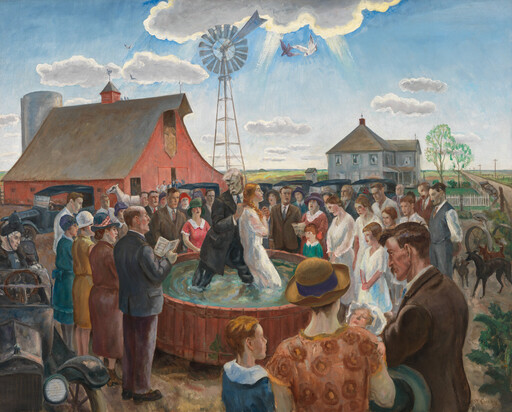
Though John Steuart Curry left his family’s farm to pursue a career as a painter on the East Coast, he returned to his Midwestern roots as subjects for his art. Baptism in Kansas, his first major painting, portrays two fundamental elements the artist associated with his upbringing: the hardscrabble landscape of his native Kansas and the religious fervor of its inhabitants. (Curry proudly avowed that he was “raised on hard work and the Shorter Catechism.”) Based on a baptism Curry witnessed on a neighbor’s farm, the painting sets the ceremony around a cattle trough amid several farm buildings, with the stark prairie landscape receding into the background. At the scene’s center, surrounded by pious worshippers singing hymns, a young woman is about to be submerged into the water by an ashen-faced preacher. The image is filled with modern details, such as the line of Model-T cars and the cattle trough, a symbol of the deep-water drilling techniques that had made the state farmable. Yet the pair of birds hovering in an aureole of light over the scene—a raven and a dove, the birds Noah released after the Flood— suggests a divine, timeless significance in the survival of these hardy individuals amid their harsh environment.
When Baptism in Kansas was first shown in 1928, critics hailed it as a departure from the abstract language and urban themes employed by American modernists. Curry’s vision of an idealized American heartland signaled the emergence of Regionalism, a nationalistic, narrative style of painting that glorified rural, homespun values during the hardships of the Great Depression.
Works in the collection
Exhibitions at the Whitney
- The Whitney’s Collection: Selections from 1900 to 1965 2019-06-28 – 2025-05-01
- Where We Are: Selections from the Whitney’s Collection, 1900–1960 2017-04-28 – 2019-06-02
- The Whitney's Collection 2015-09-28 – 2016-04-04
- America Is Hard to See 2015-05-01 – 2015-09-27
- Breaking Ground: The Whitney’s Founding Collection 2011-04-28 – 2011-09-18
- Modern Life: Edward Hopper and His Time 2010-10-28 – 2011-04-10
- Modernisms 2007-08-29 – 2008-01-13
- Benton and America in the 1930s: Works on Paper 2004-05-20 – 2004-09-05
- Highlights from the Permanent Collection: From Hopper to Mid-Century 2000-02-26 – 2006-05-21
- Permanent Collection 1998-04-04 – 1999-03-28
- An American Story 1996-03-20 – 1996-09-29
- Collection in Context: Gertrude Vanderbilt Whitney: Printmakers' Patron 1994-12-15 – 1996-04-21
- 1945 Annual Exhibition of Contemporary American Painting 1945-11-27 – 1946-01-10
- 1945 Annual Exhibition of Contemporary American Sculpture, Watercolors and Drawings 1945-01-03 – 1945-02-08
- 1943 Annual Exhibition of Contemporary American Art 1943-11-23 – 1944-01-04
- 1941 Annual Exhibition of Contemporary American Sculpture, Watercolors, Drawings and Prints 1941-01-15 – 1941-02-19
- 1940 Annual Exhibition of Contemporary American Painting 1940-11-27 – 1941-01-08
- 1940 Annual Exhibition of Contemporary American Art 1940-01-10 – 1940-02-18
- 1937 Annual Exhibition of Contemporary American Painting 1937-11-10 – 1937-12-12
- Third Biennial Exhibition of Contemporary American Painting 1936-11-10 – 1936-12-10
- Second Biennial Exhibition: Part One—Sculpture, Drawings and Prints 1936-01-24 – 1936-02-13
- Second Biennial Exhibition of Contemporary American Painting 1934-11-27 – 1935-01-10
- First Biennial Exhibition of Contemporary American Sculpture, Watercolors and Prints 1933-12-05 – 1934-01-11
- First Biennial Exhibition of Contemporary American Painting 1932-11-22 – 1933-01-05